
AI Learned to Interrupt — and Officially Became Brazilian
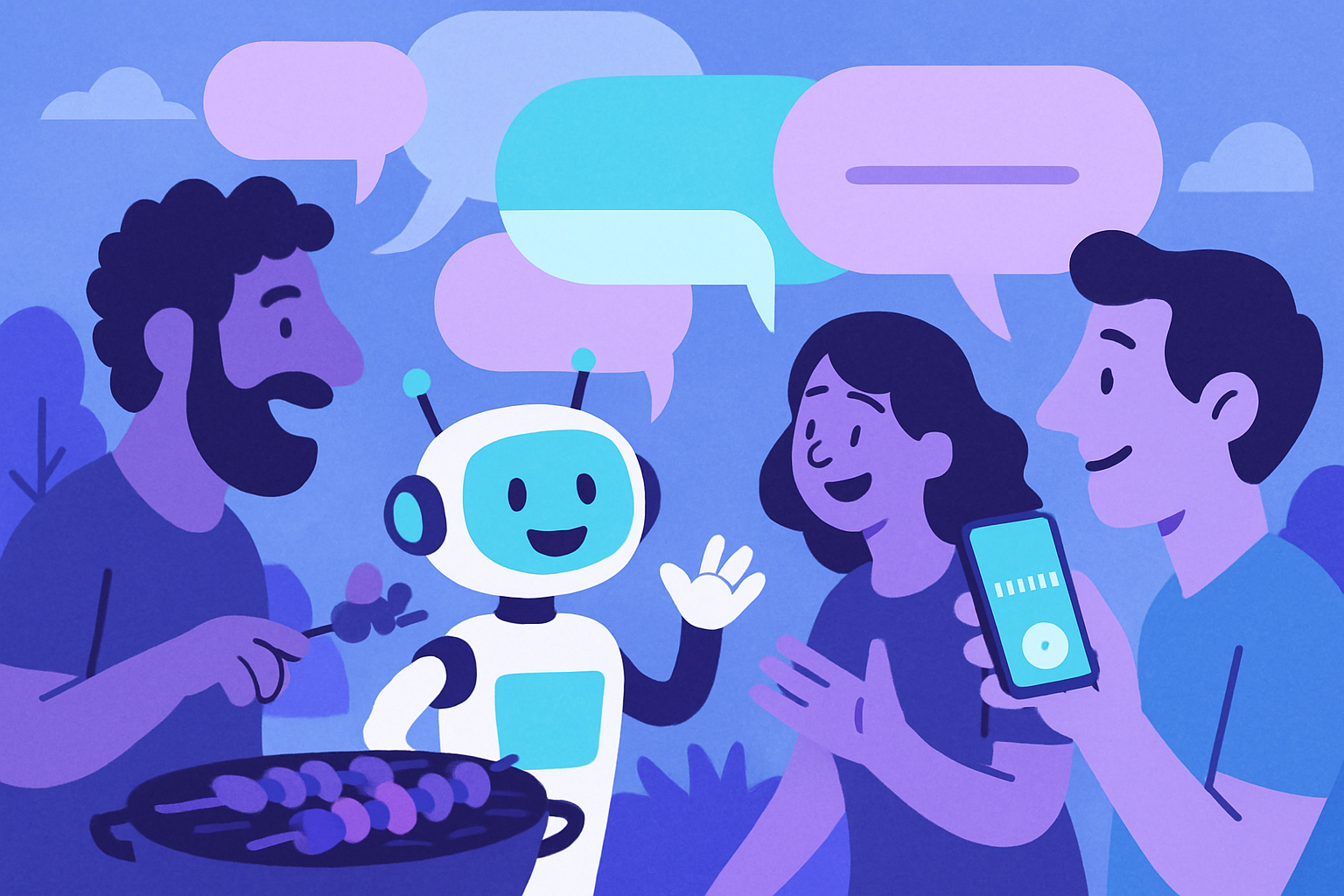
One of the most important stories in the history of technology dropped in July, and I won’t hear otherwise: ChatGPT’s new voice AI now runs in "full-duplex." Translated from corporate English: it talks and listens at the same time. It interrupts you mid-sentence.
Decades of research. Billions of dollars. The greatest minds on the planet. All of it so artificial intelligence could finally master a technology Brazilians have had down forever: the barbecue conversation.
The Ultimate Test
Scientists use complicated benchmarks to measure AI. I propose a more honest one, in three phases:
Phase 1 — The Barbecue. Drop the AI into a circle of friends where three people are telling different stories at the same time, a fourth one shouts "THAT’S A LIE, I WAS THERE," and everyone somehow understands each other perfectly. If the AI survives with its circuit sanity intact, it passes.
Phase 2 — The Family Group Chat. The AI has to read 84 unrelated messages, figure out which "good morning" with flowers is from your aunt and which one is a chain message, and decide in milliseconds whether to answer the question sent at 7 a.m. or pretend the phone was on silent. Difficulty: nightmare.
Phase 3 — The 4-Minute Voice Note. The final test. The AI receives a voice message where the person spends 3 minutes and 40 seconds on context before getting to a 5-second question — and has to answer without listening to the whole thing again. No machine is ready for this. No human is either, but we’re better at faking it.
Signs Your AI Has Gone Too Brazilian
Experts (me, yesterday, over coffee) have identified the symptoms of machines going native. Watch out if your AI shows three or more of these behaviors: replying "on my way" before it’s even processed the request; starting every answer with "so, here’s the thing"; interrupting you with "no, but you know what’s good for that?"; swearing it’ll sort it out tomorrow, no excuses; and ending the conversation with "just give me a shout" with zero intention of being shouted at.
If it shows all five, congratulations: you no longer have a virtual assistant — you have a digital brother-in-law.
The Part Nobody Saw Coming
Here’s the most ironic part of this whole story: we spent years complaining that talking to a robot was awful because it was too stiff, waited for us to finish, stuck to a script. "Ugh, I wish it felt natural, like talking to an actual person."
Well, here we are. Now it’s natural. Now it interrupts, talks back, and jumps to the next topic. And what was humanity’s first reaction in testing? "Wow, what a rude AI." There’s just no pleasing anyone.
The Moral of the Story
Jokes aside, voice technology that genuinely holds a conversation — no turn-taking, no robotic pauses — opens up serious doors for business: phone support that doesn’t feel like a maze, scheduling that flows naturally, customers who hang up satisfied instead of huffing. AI learned to talk like we do. The good news is that, unlike the brother-in-law, it works 24 hours a day and never asks you to hold its drink.
If you want an AI that has real conversations with YOUR customers — interrupting only when it should — AutoFluxo AI builds that for your business. Diagnosis. Solution. Result. And zero 4-minute voice notes, promised.
Next step
Ready to bring this to your business?
Tell me about the pain point you want to solve. The first conversation is a diagnosis, not a sales pitch.